
Who Is Jesus? What Is Jesus' Mission? Who Are Jesus' Followers? A study of Matthew 16:13-26

It's not your church. It's Jesus' church.
Bible Study Ideas and Commentary for Matthew 16:13-26
In this amazing passage, the disciple finally have revealed to them that Jesus is the Son of God, the Savior of the World, and through them Jesus is going to start a new movement that will change the world. But they must set aside every worldly attitude and thought they ever had and listen to Jesus alone, because their lives no longer belong to them.
If anyone wants to follow after me, let him deny himself, take up his cross, and follow me. (16:24)

Extra Resource for the Week
This week's is one of the most amazing passages in the Bible and one I studied a lot in seminary. I put a lot of work into my notes the last time we studied this passage, and I encourage you to skim through them:
Topics I covered there in more depth than I probably will this week:
"The Son of Man"
"Messiah"
"Peter"/"rock"
"Church"
"The keys to the kingdom"
Getting Started: Things to Think About
Warning: Big Passage
Be aware -- this week's passage is shockingly long and packed. Save lots of time to talk about the text. The power is in the Word of God, not us.
Great Nicknames
In this week's passage, Jesus gives Simon the nickname "Peter". It's such a great nickname that we all pretty much call him Peter.
My best modern nickname parallel -- "Magic" Johnson. I was a teenager before I realized that wasn't his name. What are your favorite nicknames that other people have?
Open Mouth, Insert Foot
In this week's passage, Peter says . . . the wrong thing. And my goodness, if it weren't for people saying things the wrong way, what would these news agencies have to talk about?
So, it's mea culpa time! When's a time you stuck your foot in your mouth? (I'll try to narrow it down to just one.) It seems that most of the times I run into trouble in life, it's my own doing ("me and my big mouth" if you would). But what Peter said? Just wow.
The Hardest Initiation/Training You've Ever Done
I'm not sure why Basic Underwater Demolition/SEAL training preparation is online, but it is. It looks intense.
But then again, Special Forces also has a training program online.
I particularly like the introduction: "Do you really want to be a Special Forces Soldier?"
What's the hardest thing you've trained for? Or another way of looking at it, what's the hardest thing you've been a part of?
Let that set the tone for this week's study. Jesus says some much more intense things about what it means to follow Him.
Teens and AI
It's been a couple of weeks since this study came out, but I wanted to hold it for this week's study. Pew Research released a very anticipated study about teenagers and their use of AI --

It's a big, long study, and I think it's worth your time (if you have teenagers in your life).
If you don't have teenagers in your life, you can just ask this question of yourself: "How do teens (or 'I') use AI in my daily life? What kind of an influence is it having on them/me?" Again, if you don't know the answer already, read that study.
Of course, AI just slots into a long line of "influencers", so this topic does not have to be AI-focused to be equally valid. In this week's passage, Jesus scolds Peter for having a human/worldly mindset, not a heavenly one.
The "problem" is that a heavenly mindset can only come from God. If we're listening to ourselves or the world around us, we're always going to get a human mindset. We have to listen to the Bible or what we call "the mind of Christ" that comes when God's people are listening to the Spirit together.
By definition, AI (and I'm mainly thinking about the tools people use like ChatGPT and Claude) cannot do that. Instead, those tools "work as giant statistical prediction machines that repeatedly predict the next word in a sequence. They learn patterns in their text and generate language that follows those patterns." Based on what most people say on the internet, those AI tools predict the next word they think you want to hear. There is no spiritual inspiration, no divine guidance. They are giving you a compilation of what the world says about a matter.
The purpose of this topic would be to help your group see the limitations of AI tools for spiritual guidance (or any guidance, for that matter). And then it joins a very common warning we should be giving to all of our Christian friends: be careful who you're listening to.
And this leads directly into my next idea:
Priests and AI
Coincidentally, about a week after the Pew study was released, the pope had a closed-door meeting with some of his people --
“To give a true homily is to share faith,” and artificial intelligence “will never be able to share faith,” the pope added.
Basically, he's thinking along the same lines that I was before. Here's the likely mindset of the priests in question: "Every homily ever written (in the hundreds of thousands) is available online somewhere; ChatGPT can compile a new homily from all of the great homilies already written. I sound good, and I don't have to do any work."
The question is simple: "What's the problem with that mindset?"
I'm with the pope on this one. (AI makes strange bedfellows, as the saying goes. Kinda.) And if the pope believes that, how much more should Bible-believing Baptists believe that?
The question becomes -- if AI is not divinely inspired, what is it good for in Bible study? I've talked about this with our Sunday School teachers. AI is a very useful tool for brainstorming -- in a matter of seconds, it can give you a list of thirty learning exercises for every learning type for a given topic. That's incredibly useful. Having trouble remembering if those words are a Bible verse or a song lyric? AI can settle it quickly. Use it to help you brainstorm. Use it to find simple/clear/yes-or-no answers that you can doublecheck easily.
[That's also why I'm still not using AI in any of my notes prep. If AI is scouring the internet to give you your answers, the last thing I need to do is put more AI stuff into the notes that AI is searching.]
This Week's Big Idea: It's Not Your Church.
It's Jesus' Church.
I really don't have a lot to add to that title. If we figured that out, I think most of the problems we run into in our churches would be prevented.
I saw this headline this morning --
“We have purchased a big building … And I’m going to ask you to provide the provision.”
As far as I can tell, he made the purchase and then told the church they were going to pay for it. I don't know what to do with that. As far as he is concerned, it's his church, and he will make the decisions for it.
Another situation that I saw yesterday makes me even more concerned.
“Pam and I are still called to pastor in Colorado Springs,” he wrote. “We received this mandate 18 years ago, and the calling has only grown stronger.”
If you don't know the details of either of those pastors and their churches, just know that they were fired from churches for various moral failures. In the case of Driscoll, he moved to another state and picked right back up where he left off. In the case of Boyd, he's waited eight months to start a new church where he can set the accountability structures.
When the topic of "Jesus' Church" comes up in the lesson, you might draw a chart on a whiteboard like this:
My church Jesus' church
Rules
Priorities
Leadership
Purpose
(pick any category you think appropriate)
We all call the churches we're members of "my church". That's good and healthy -- you should be very personally connected with your church family. But when some people (apparently) say "my church", they mean that in the possessive. That's the attitude I'm talking about here.
If you think of the local congregation you're a part of as "my church", how would the [rules] be determined? If you think of that congregation as "Jesus' church", how would the [rules] be determined?
Note that I'm not asking you guys to write down what those rules are! You do not have the time to go into that. You're just hypothesizing how those rules would be determined.
I'm not suggesting that the phrase "it's Jesus' church" is a magic cure-all for every disagreement in a church. People have been manipulating what Jesus said for two thousand years. But I hope you see where I'm going with this.
What would your church be like if every member thought of it first as Jesus' church?
If you want to brush up on your ecclesiology, here are some resources:
What is the church? | GotQuestions.org (note they're nondenominational)
Ecclesiology: What Do We Believe About the Church? (a logos resource)
Church, the Meaning - Bible Definition and References | Bible Study Tools
Bonus Big Idea: When Jesus Is Not Lord
Yet another harrowing headline I saw this week:
Here's the lede: "Under a new “ethnic unity” law, Mandarin Chinese must now be the language of teaching. Parents must guide their children to love the Communist Party. Neighborhoods should be mixed." The whole thing is pretty horrifying; that article has the best short summary (that I've read) of what's going on.
Here's my point. This is simply an illustration of a deeper truth about people: leaders want to shape the people and organizations below them after themselves. And even if they don't think they want to, it's going to happen.
When Jesus is Lord, that's exactly what we want to have happen.
Remember what Paul said to the church in Corinth:
1 Cor 11:2 Now I praise you because you remember me in everything and hold fast to the traditions just as I delivered them to you.
But the verse before establishes his real point:
1 Cor 11:1 Imitate me, as I also imitate Christ.
When the leadership is focused on Christ, the congregation will follow that.
But when Jesus is not Lord, may God have mercy.
Where We Are in Matthew
We are still in the section where Matthew illustrates the rising tension between Jesus and the established religious authority.
Part 5: Progressive Polarization (13:43-19:2)
More rejection, bigger miracles (13:53-17:27)
Fourth teaching (Life under Kingdom Authority) (18:1-19:2)
Last week, we studied 15:1-20, where Jesus openly called the Pharisees hypocrites who were blindly leading the people far from God.
Immediately after that is the powerful story of the Canaanite woman who demonstrates great faith in Jesus. This story often gets misunderstood; know that Jesus took it as an opportunity to prove to His disciples that their mission would expand far beyond Jews only.
Then there's another miraculous provision of food, another ridiculous challenge by the Pharisees (and Sadducees).
And then there's this week's passage, where Matthew ratchets the tension to a maximum: Jesus is the very Son of the living God, and the Jewish authorities will put Him to death.
This is a turning point in Matthew's Gospel.
Where We Are in Israel
It's worth pointing out the map. This map smashes a lot of events from the Gospels into one. The numbers are the sequence. For our part, we are noting (13) Caesarea Philippi and (14) Mt. Hermon (but more on that next week).

Matthew 16:13 says that Jesus took His disciples to the region of Caesarea Philippi. That's not a coincidence. It's a beautiful location on the slopes of Mount Hermon, well-watered and filled with lush groves. And for at least 800 years (300 BC - 500 AD), it was a major religious center. The Canaanites worshiped Baal-gad and his son Aliyan there, and the Greeks had shrines to Pan and his Nymphs there. Caesar Augustus gave control of the region to Herod the Great in 20 BC, and Herod built a temple to Augustus. When Philip took over after Herod's death, he rebuilt the entire city and named it Caesarea Philippi. Here's a rendering from the Israel Information Center of what this site might have looked like in its heyday of the late first century (note that the city was also known as Paneas):

What's the point? Caesarea Philippi was a center of worship for Canaanite gods, Greek gods, and Roman gods (meaning the emperor). So when Jesus asked His disciples, "Who do you say I am?", He was suggesting them to think big picture.
For next week, when we study the Transfiguration, keep this location in mind. There's a consensus that the Transfiguration took place on Mount Hermon, which we studied last summer when we studied Psalm 42:
Fun fact: on a clear day, you can see Mount Hermon from Nazareth!
Part 1: Who Is Jesus? (Matthew 16:13-20)
13 When Jesus came to the region of Caesarea Philippi, he asked his disciples, “Who do people say that the Son of Man is?” 14 They replied, “Some say John the Baptist; others, Elijah; still others, Jeremiah or one of the prophets.” 15 “But you,” he asked them, “who do you say that I am?” 16 Simon Peter answered, “You are the Messiah, the Son of the living God.” 17 Jesus responded, “Blessed are you, Simon son of Jonah, because flesh and blood did not reveal this to you, but my Father in heaven. 18 And I also say to you that you are Peter, and on this rock I will build my church, and the gates of Hades will not overpower it. 19 I will give you the keys of the kingdom of heaven, and whatever you bind on earth will have been bound in heaven, and whatever you loose on earth will have been loosed in heaven.” 20 Then he gave the disciples orders to tell no one that he was the Messiah.
Let's be honest -- this section could easily be the entire lesson. In order to hit the highlights, I'll send you to my previous post on this passage for more:
I've already mentioned the significance of being near Caesarea Philippi, and I gave a section on "Son of Man" in the post linked above. (Jesus switching between "Son of Man" and "I" is your proof of who the title refers to.)
The disciples spent all of their time around Jews, so it makes sense that they would offer answers related to Judaism.
The key to this question is the shift: "Who do you say that I am?" Yes, Jesus cared what "people" thought, but in that moment He primarily cared what they thought. Themselves. Not what "people" thought -- what they thought.
This is why we do Sunday School, y'all. When push comes to shove, Jesus doesn't care what other people think -- He cares what you think. It doesn't matter that "somebody out there" said such-and-such -- it matters what you believe. (And when Jesus has this same discussion one-on-one with every other person who has ever lived, they will then be the center of inquiry.) There are a lot of religions and philosophies out there, and each has an opinion about divinity and truth and power. Are we going to try to explain Jesus in terms of what the rest of the world thinks, or will we let God the Father tell us what that truth is? Jesus is not just the Messiah of the Jews; He's the Savior of the world.
If you really want to be Jesus' disciple, He really wants to know what you really think about Him. (Yes, that's a play on the Special Forces manual above.)
Peter was the first one to get out of the boat, and he's the first one to jump into this discussion. And his answer is perfect. Why? Because he didn't make it up -- God the Father revealed it to him.
First, he calls Jesus "the Christ" ("Messiah") -- meaning that Jesus is certainly the One prophesied in the Old Testament. Second, he calls Jesus "the Son of God" -- which are words the disciples have used before, but now with God the Father's enlightenment mean what we use them today to mean.
And no, I don't think I would go into a detailed explanation of the Trinity. You have too much else to talk about. And I can't imagine that Peter fully grasped what his words could have possibly meant. Address it, make sure everybody is reasonably good with it, but save a detailed Trinity lesson for another day.

Here's where things get testy.
Peter / Rock / Church / Keys
There are two umbrella approaches to this text. In the first, Peter represents all believers. In the second, Peter is unique -- a new super-rabbi. In the first, the church is built on Peter's confession. In the second, the church is built on Peter himself.
If you sniffed in that second approach that Peter sounds like a "pope", you nailed it. That interpretation of this very passage is where the Roman Catholic Church derives its justification for its structure.
But that's really stretching the text.
Rather, Peter -- in that moment -- became the "first" disciple. No, he doesn't have the Holy Spirit yet, but he does have the supernatural revelation that Jesus Christ is the Son of God. Likewise, that is the first step of discipleship for each of us. We "confess with your mouth, 'Jesus is Lord,' and believe in your heart that God raised him from the dead" (Rom 10:9) and come to Jesus for forgiveness and salvation. In that, Peter was not unique -- he was the first of many.
It might shock you to be reminded that Peter's birth name was actually Simon. Jesus then gives him the nickname "Peter". Now we have to get into some language weeds.
Jesus used an Aramaic word that transliterates to "Cephas", the Aramaic word for "rock". (Note: this can be used of a massive rock.)
The Greek equivalent word is "Petros", which is their word for "rock". In the Greek, "Petros" is used of Peter, and "Petra" (the feminine form) is used of the foundation. Some people have tried to make a big deal out of that ("Peter is a mere stone, but the confession is a giant rock"), but that's only how it translates into Greek. Peter is male, y'all. Aramaic didn't have that gender distinction.
So, what's going on? Jesus is the builder of the church. And Jesus builds His church on the confession that Jesus is the Messiah and Son of God -- a confession that was revealed to Peter by God the Father. This means that the church is built by Jesus on the revelation of God.
Jesus is the builder. God's truth is the foundation. It's that simple.
What Jesus is building is a church. We know all about churches today, but this is the first time the word of used in our sense. Ever. In history. The word means "call out from" or "called out ones" in the Greek, and that is the sense in which it is used in the rest of the New Testament. Why did Jesus mention it here?
I think it's geography again. The disciples had seen synagogues and temples, but in Caesarea Philippi there were shrines and other temples (the Temple of Augustus -- the Augusteum -- was quite famous in the Roman Empire). Jesus isn't building a temple. He isn't even building a synagogue (which means "place of assembly"). He's building a people -- a community.
And this community has . . . these keys. What does that mean? In Roman Catholic interpretation, it means that the pope gets to decide who is worthy of forgiveness and heaven. That's not great scholarship.
Rather, the CSB has the right of the difficult translation:
I will give you the keys of the kingdom of heaven, and whatever you bind on earth will have been bound in heaven, and whatever you loose on earth will have been loosed in heaven.
The verb is future perfect. It does not have the force of saying that humans can determine what will be done in heaven. (That's the attitude of those church leaders who believe it to be "their church" before it's Jesus' church.) That would be a different future tense. Rather, the future perfect suggests that just as God has revealed this foundational truth to Peter, God will also reveal all foundational truths ("binding" and "loosing") to and through His church.
In other words, the church Jesus is founding will be the sole source of God's truth on earth.
That's as dramatic as a statement gets.
Why didn't Jesus want the disciples to pass this along along? Just add the word "yet". "Loose lips sink ships" right? Jesus wanted to control this narrative -- he didn't want it getting out through a careless slip of the tongue.
Part 2: What Is Jesus' Mission? (Matthew 16:21-23)
21 From then on Jesus began to point out to his disciples that it was necessary for him to go to Jerusalem and suffer many things from the elders, chief priests, and scribes, be killed, and be raised the third day. 22 Peter took him aside and began to rebuke him, “Oh no, Lord! This will never happen to you!” 23 Jesus turned and told Peter, “Get behind me, Satan! You are a hindrance to me because you’re not thinking about God’s concerns but human concerns.”
But wait! That first section wasn't the end of the lesson!
I'm going to keep the rest of my notes short.
"From then on" means that a turning point has been crossed -- Jesus now openly talks about His coming death with the disciples. Obviously, they don't handle it well. Earlier in the Gospel when Jesus was more vague about it (9:15, 10:38, 12:40), they could ignore it. Not anymore.
We know what Jesus is talking about. Easter is in three weeks! But this is still "news" to the disciples.
I think verse 22 is where "The Chosen" got a lot of character inspiration for their Peter. Peter was willing to take Jesus aside. Think about that! Peter was directly contradicting something Jesus said.
We don't know how much time had passed between verse 16 and here, but certainly not long enough for anybody to have forgotten. Peter, who had spoken truth revealed to him by God the Father, now spoke against God the Son from a truly non-divine mindset. (This is further proof that Matthew never intended anyone to conclude that Peter was foreshadowing a perfect pope.)
What's Jesus so upset by? Any attempt to apply human logic to His divine mission will result in disaster and damnation. In other words, an exact tool of Satan.
You might reframe some of my earlier comments as "What would happen if we approached God's church as a human organization and applied human rules to it?"
Here, we can make this even more personal: "What would happen if I lived my life by my rues (which would be rules I learned from the world around me?" How is your life different because of Jesus?
(I recommend using the Sermon on the Mount as a framework for this discussion. And if you don't live any differently from the non-Christians around you, I implore you to search your heart and ask if you are truly a Christian. But more about this in the next section.)
Part 3: Who Are Jesus' Followers? (Matthew 16:24-26)
24 Then Jesus said to his disciples, “If anyone wants to follow after me, let him deny himself, take up his cross, and follow me. 25 For whoever wants to save his life will lose it, but whoever loses his life because of me will find it. 26 For what will it benefit someone if he gains the whole world yet loses his life? Or what will anyone give in exchange for his life?
Peter's worldly mindset is unacceptable for a follower of Jesus. If we try to apply a worldly mindset to Jesus' divine mission, we will end up in a pit with the blind leading the blind.
If we want to be a disciple (follow Jesus), we must deny ourselves. This means everything about the mindset and priorities we had for ourselves that were given to us by the world. Instead, we "take up our cross".
This does not mean "wear a cross necklace". No offense to cross necklaces. Roman crosses were instruments of torture and death. They were a symbol of sacrifice and shame. To take up one's cross meant to join Jesus on His journey to self-sacrifice, following and listening to Jesus and only Jesus.
In 2016, I mentioned the book Not a Fan. It's still a great book (and it's cheaper, now that it's been out for so long). Are you a follower of Jesus, or just a fan?
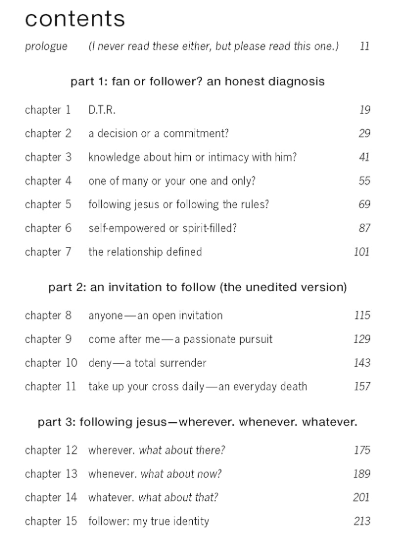
You obviously don't have time to go through that entire book at the end of a Bible study meeting, but you could use that to help you figure out how you want to explain what it means to truly be a follower of Jesus.
And why? Why is Jesus so serious about this? Because eternity is at stake. This is no game, any more than it was an innocent disagreement with the Pharisees. Human souls are in the balance, and if we step off of Jesus' path, we lose the only message and witness that can save those souls from hell.
All Satan can offer is the mindset of the world -- which he did to Jesus in the temptations. Do you want your reward in full right now? Satan can get it to you. At a terrible eternal cost.
But if you're willing to follow Jesus now, being willing to sacrifice everything about yourself to His cause, your eternal gain is incalculable.
Note: this doesn't mean that every true Christian will be martyred. We've talked about this before. We live in a country where martyrdom is extremely rare. But would be willing? Would you be willing to put your life and your comfort behind following Jesus?
This would be your time for self-examination. In what ways do you put your own priorities before that of Jesus? In what ways do you listen to worldly advice before the Word of God? In what ways are you holding back from truly following Jesus?
If you are a Christian, the Holy Spirit has already been convicting you of those things. It's time to listen. And as we say in Baptist churches, it's time to surrender.


Comments