
Checking In on Distributing the Promised Land -- Joshua 14:1-15

Caleb is the hero we need.
Bible Study Ideas and Commentary for Joshua 14:1-15
In our only lesson for the entire part of Joshua about conquering and dividing the Promised Land, we focus on the Levites and Caleb. God expected the Israelites to take care of the needs of the priests (and He gave them their own cities to live in). And we also have the conclusion of the heroic life of Caleb, a man who remained ever faithful to God.
You know what the Lord promised Moses the man of God at Kadesh-barnea about you and me. (14:6)

Getting Started: Things to Think About
I have a bunch of miscellaneous ideas for discussion topics this week. One or two might connect with your group.
Return of the Good Guys
Somewhere around the time that we moved back to Texas (2006ish), the Rockets traded for Shane Battier and ran a "Return of the Good Guys" ad campaign with Yao Ming and Tracey McGrady. I couldn't find a record of that on the internet (?!), so I included this marvelous photo that includes Ron Artest (iykyk).

The point of the campaign was that these were quality humans that you would feel good about rooting for. It's a common and effective campaign strategy.
My idea for a topic is something like "Does character influence your rooting interests in sports?" It certainly does for me. When "my" team picks up an unsavory character, I'll still root for them, but it leaves a bad taste in my mouth.
This leads to fun collisions like the Los Angeles Dodgers, whom I hate, but they have Freddy Freeman and Mookie Betts and Shohei Ohtani, whom I like. So, huh.
Obviously, this week's passage is us about Caleb, who basically has a 100% approval rating.
The Gritty Veteran Athlete You Cheer For
Another take on that topic would be the "gritty" or "grizzled" veteran you root for. Enter the World Cup. Having the stars in it has been a boon for them -- particularly Messi and Mbappe and Haaland. But Messi is the old guy, which I think has given him a real boost in popularity (in some circles). How about for you? Do you like to root for the athlete who has worked hard and long and has success late in a career?
If you're not into soccer, maybe it's tennis. I'm shocked to say that Djokovic has made it to the semis of Wimbledon at 39! And it was a marvelous story that Serena played in Wimbledon this year at 44!! Take your pick of sports and athletes -- does achievement later in life inspire you?
In this week's passage, Caleb is at least 85 years old and conquering fortified positions.
How Do We Pick Our "Heroes"?
I don't follow Maine politics, but I know enough about this story to be dangerous. There was a handsome, charismatic man running for Maine senator with a bold, progressive politic, and he got a bunch of people excited about his campaign. But apparently they all overlooked some major red flags in his background, particularly in terms of behavior toward women. [Update: I just saw that he dropped out of the race.]
I'm thinking of a topic like "how do we determine who gets put on a pedestal?" What are the characteristics we tend to focus on? It does regularly seem to be "attractive, charismatic, bold, and accomplished". Depending on how your group answers that, follow up with either "should we also consider character?" or "how important is character on that list?"
To me, that's what sets Caleb apart. Yes, he was bold and a man of action, but he was a man of faithfulness toward God and his people. That's what makes him a true hero (not just of our faith, but period).
The Case for Boring
This idea is just a variation of that last one. "Do you want your heroes to be in the news a lot of not?" If you follow the NBA, you'll know that Boston just traded their star Jaylen Brown (and kept their star Jayson Tatum). One of many talking points was the personality difference between the two -- Brown is outspoken and regularly posting on Twitch; no one really knows anything about Tatum except that he loves to hoop and he loves his family. Personally, I like that about Tatum. I like boring when it comes to a public face. "Boring" means they aren't attracting attention for the wrong reasons.
Would you rather your "hero" regularly be in the news, or be seen as boring?
A very simple exercise would be to look up everything the Bible says about Caleb. Basically, the only times the Bible talks about him, he's either demonstrating his faith in God or his loyalty to his people. To me, that's wildly impressive. (Note: the word "brother" in one of those passages really means "younger relative". It's an important distinction to me.)
Caleb and Joshua -- Two Different Endings
You may come back to this idea at the end of your group time after you've talked about the passage. Basically, my idea is either "which of these two men is more sympathetic to you?" or "which of these men's stories is more appealing to you?"
It's Been a Long Time Coming (the Caleb Topic)
In this week's passage, Caleb finally gets his hero's ending. After 80+ years of faithful service, he asks for (and receives) permission to conquer land for his own family. Always in the background, always putting others first, and at the end of his life finally gets to achieve something for himself and his descendants.
Not in Your Lifetime (the Joshua Topic)
The setup to this week's passage is God's statement to Joshua:
13:1 Joshua was now old, advanced in age, and the Lord said to him, “You have become old, advanced in age, but a great deal of the land remains to be possessed."
Thanks, God. God's point was that Joshua would not live to see the entire task finished, so he needed to put all of the mechanisms in place to ensure that the people would get the job done after his death. Joshua had amazing accomplishments . . . but he would die before seeing it to the end.
Which of those two life stories is more sympathetic to you or appeals more to you?
This Week's Big Idea: How Many Countries Are There?
This week's passage is the only time we really talk at all about the division of the land. This is usually the time when Bible readers get confused about how many tribes there are because the list of "states" doesn't match the list of Jacob's sons.
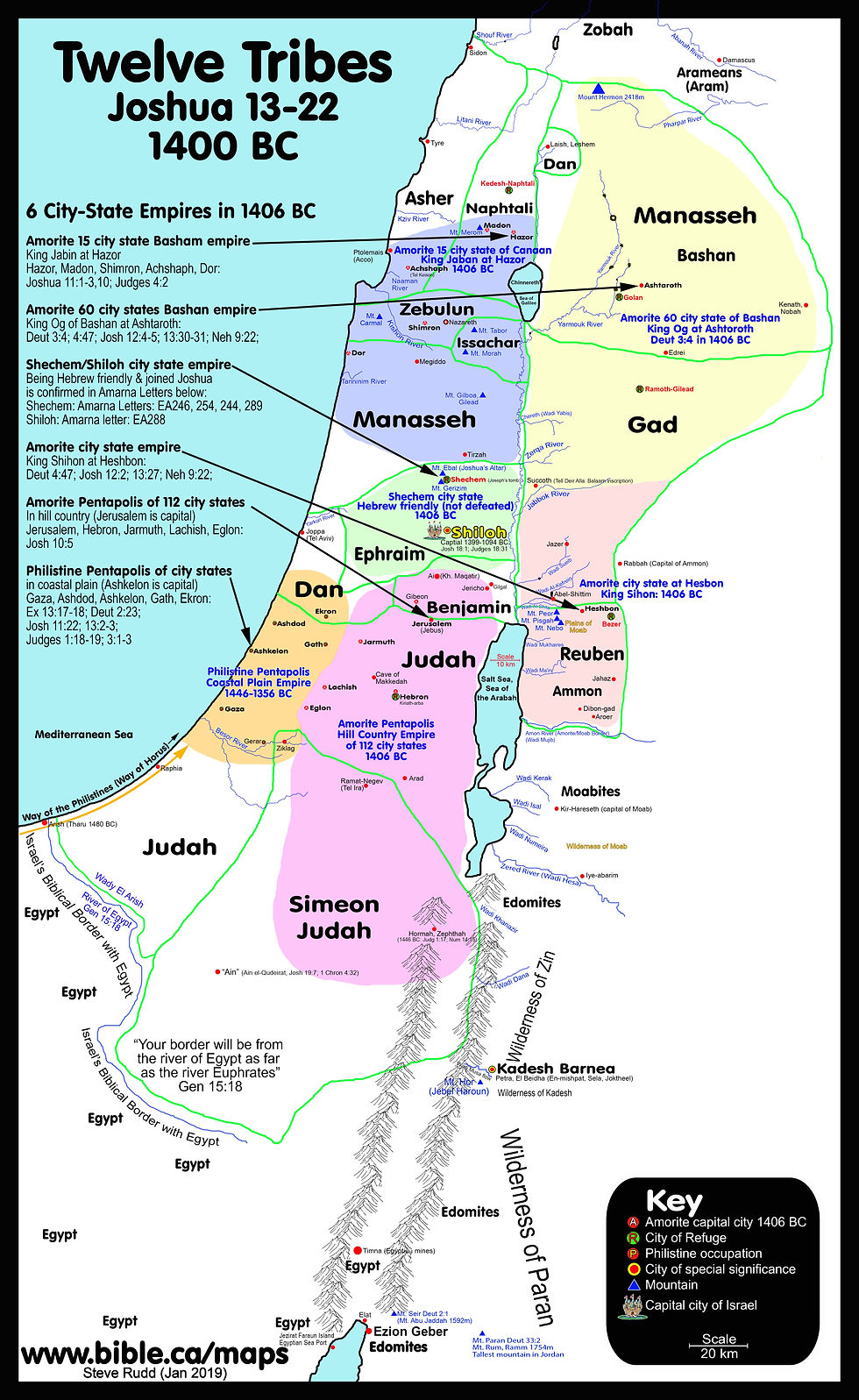
This guy put a lot of work into depicting how complicated the division of the land really was (and how incomplete the work of conquering the land really was).
Part of the confusion is the simple fact that the Levites did not get their own territory, so Joseph actually got two allotments (for his sons Ephraim and Manasseh). And part of the confusion is that the settlements were a bit "messy" and not following strict boundaries.
To me, this is a great opportunity to share a CGP Grey video:
If anyone in your group complains that the whole "tribal allotment" section is confusing, just ask the question, "How many countries are there today?" It turns out to be an incredibly complicated and confusing rabbit hole. This week's "big idea" is really just a lighthearted way to say that the map wasn't any more confusing in Joshua's day than it is today.
Bonus Big Idea: Churches and Pastor Compensation
A more serious "big idea" focuses on the Levites. God did not give the Levites their own territory -- He wanted them to be distributed throughout the land of Israel. Because wealth and inheritance was entirely tied to land (in that agrarian economy), this meant that the Levites were dependent on the people of Israel to take care of them.
[Note: without going into it, this was an ongoing battle of balance. When Levites were allowed to abuse the system and get rich, they neglected their priestly duties to enjoy their wealth. Conversely, when Levites were not adequately cared for, they had no choice but to neglect their priestly duties in order to put food on the table.]
My church takes care of me, so this is not a deceptive way to ask for a raise. But people in a lot of churches read this blog, so I'll ask the obvious question that all church members do need to consider regularly: does your church adequately care of for the needs of your pastor(s) and staff? If you expect them to work "full time" for you, are you paying them well enough to meet their needs and prepare for retirement? If they are bivocational, are you giving them adequate space to work another job that meets their financial needs?
I'm not going into detail on this this week; we've talked about it before. My point is simply that God expected His people to take care of the priestly tribe of Levi. Do you feel good about how you are taking care of your pastor(s) and staff?
[Addendum -- I just got this article in my email: Pastor wellness: How does a church know it’s caring well for its pastor? - The Christian Index]
Where We Are in Joshua
We only have two lessons for the last 16 chapters of Joshua. That means we're doing a lot of skipping. To be fair, a simple outline will get you caught up:
Chapter 8: Ai is conquered
Chapter 9: the Gibeonites deceive Joshua to save their skins
Chapter 10: Joshua rescues the Gibeonites (this is the sun-stands-still chapter)
Chapters 11-12: the rest of the military campaign
Chapters 13-21: the division of the land*
Chapter 22: the eastern tribes return home
Chapter 23: Joshua's farewell
Chapter 24: the covenant is renewed
There's some interesting stuff in there, but a lot of it is "dry" and detailed. The map that I shared above from Steve Rudd does a good job of putting what these chapters say into map form (note: there is no firm agreement about the detailed boundary lines!!). He also draws attention to how incomplete the military campaign was at Joshua's death.
I put the * on that outline to highlight that Joshua was allotting land that still had Canaanites living in it. It was going to be the responsibility of those tribes to finish the process of cleansing their land of the Canaanite evil. Guess how well they did at that.
That's probably the most important thing I can say to help everyone understand these chapters. Joshua's campaign had "broken the back of the resistance" of the Canaanite tribes. He had conquered their main military enemies and given the people a solid foothold in the land. And then he identified the boundaries of each tribal inheritance. But he did not personally lead the campaign to eliminate every square foot of resistance. The people had their own responsibility to complete this task.
Part 1: The Inheritance (Joshua 14:1-5)
The Israelites received these portions that the priest Eleazar, Joshua son of Nun, and the family heads of the Israelite tribes gave them in the land of Canaan. 2 Their inheritance was by lot as the Lord commanded through Moses for the nine and a half tribes, 3 because Moses had given the inheritance to the two and a half tribes beyond the Jordan. But he gave no inheritance among them to the Levites. 4 The descendants of Joseph became two tribes, Manasseh and Ephraim. No portion of the land was given to the Levites except cities to live in, along with pasturelands for their cattle and livestock. 5 So the Israelites did as the Lord commanded Moses, and they divided the land.
It's impossible to know exactly how this worked.

Someone might have in mind something like the draft lottery, where Joshua is Adam Silver, Eleazar is the deputy commissioner, the family heads and the team representatives, and God is the magic ping pong ball machine.
That's, . . . No.
Joshua is of course there as the leader of the people. Eleazar was the High Priest at the time. We don't know how this worked, but the language makes it clear that God was completely sovereign over which parts of the land went to which tribes. There was no arguing or negotiation -- God distributed the land, and the leaders were there to observe the process.
[Aside: so what about the Transjordan Tribes? Didn't they negotiate their own land? Yes they did -- they negotiated that land with Moses. Ding ding ding -- there's your red flag. That wasn't part of the Promised Land that God had for His people. If they wanted "lesser" land, God would allow them to have it, but it was lesser land. Think about when Abraham and Lot went their separate ways -- it's much like that. God will let you pick your own land, or you can let God pick the land for you. Which do you think will turn out better?]
[Note: the "half" is because only half of the tribe of Manasseh wanted to stay on the far side of the Jordan.]
These comments about the Levites are very important. These are the consequences of their responsibilities (and privileges) before the Lord:
Deut 10:8 “At that time the Lord set apart the tribe of Levi to carry the ark of the Lord’s covenant, to stand before the Lord to serve him, and to pronounce blessings in his name, as it is today. 9 For this reason, Levi does not have a portion or inheritance like his brothers; the Lord is his inheritance, as the Lord your God told him.
Because the New Testament is not a "New Old Testament", Christians are not "New Jews" and pastors are not "New Jewish Priests". Keep that in mind when we try to learn principles from this passage. Why would God not let Levites own land, and what lesson can we learn from that today?
It's actually pretty simple. Priests weren't supposed to be in it to get rich. They were to be satisfied with their lot so that they could put their focus on their priestly responsibilities.
I've heard some people try to claim that this is why pastors should live in pastoriums/parsonages. Huh? Read the rest of the passage! Sure, they didn't have land, but they had their own cities. They had houses. They had access to pastures for their livestock. There was full "personal property" among the priests.
But God wanted the priests to be spread throughout His people, and this is how that would happen.
Aside: Inheritance and Land
When we talk about God's covenant with the Israelites, we should emphasize the three-fold promise:
they will be a nation (a people)
they will have a land (a home)
He will be their God
So, the "land" (the physical location of Israel) is a key part of God's promise to His people. In fact, some versions of the Bible translate the word "inheritance" in this chapter as "land" because the "inheritance" God speaks of is specifically the physical territory He is giving them in the Promised Land. The Levites did not receive any of that. Instead, as I shared above, God Himself was their "inheritance". If you want to stretch people's minds, ask a question like "what does it mean that God was the Levites' inheritance, and would you rather have that inheritance or the physical land given to the other tribes?" (And if your group starts to get nervous about all of this talk, remind them that we are under the New Covenant in Christ.)
Part 2: It's Caleb's Time (Joshua 14:6-9)
6 The descendants of Judah approached Joshua at Gilgal, and Caleb son of Jephunneh the Kenizzite said to him, “You know what the Lord promised Moses the man of God at Kadesh-barnea about you and me. 7 I was forty years old when Moses the Lord’s servant sent me from Kadesh-barnea to scout the land, and I brought back an honest report. 8 My brothers who went with me caused the people to lose heart, but I followed the Lord my God completely. 9 On that day Moses swore to me, ‘The land where you have set foot will be an inheritance for you and your descendants forever, because you have followed the Lord my God completely.’
I don't know why Lifeway divided this passage into two.
If you didn't look up Caleb in your Bible app yet, do it now. It won't take long to review every time he's mentioned in the Bible. And every time is pretty heroic. (Even the weird part of giving his daughter away in marriage is more about the loyalty to his people; remember that they didn't marry for "love" in those days.) [Note: The Kadesh-barnea incident is found in Numbers 14.]
Catch what Caleb was saying:
Moses (!!) believed I had been completely faithful to God (!!!) my entire life (!!!!).
Joshua, you know that I have continued to be fully faithful to God ever since (!!!!!).
And he wasn't bragging! He was using this to explain that he was only asking to be allowed to fulfill the promise God made to him decades before! This is wonderful.
Caleb the Kenizzite?
I've clearly missed this my entire life. Caleb is associated with the tribe of Judah, but his father was a Kenizzite. Kenizzites were a tribe descended from Edom (Gen 36, Judg 4). This would mean that Caleb wasn't a "full-blooded Jew" but a foreigner who had joined Israel by choice. If that's how we're supposed to read this (and there's debate about this), I think that's profoundly symbolic (and appropriate) that one of the two heroes of the Exodus was not a Jew by birth. A wonderful peek ahead to God's plan for the nations.
The Lifeway material recommends this very appropriate question: What does it mean to follow the Lord wholeheartedly? I would add this interesting deeper question: what is the difference between "following the Lord wholeheartedly" and "never sinning"? (I think it's extremely important to make it clear that the Bible never suggests that Caleb was without sin.)
Translation note: the Hebrew phrase translated "followed wholeheartedly" is literally "I filled up after the Lord my God". Does that help you get a better sense of this meaning? How might this connect with Paul's command in Ephesians 5:18?
Part 3: Promise Kept (Joshua 14:10-15)
10 “As you see, the Lord has kept me alive these forty-five years as he promised, since the Lord spoke this word to Moses while Israel was journeying in the wilderness. Here I am today, eighty-five years old. 11 I am still as strong today as I was the day Moses sent me out. My strength for battle and for daily tasks is now as it was then. 12 Now give me this hill country the Lord promised me on that day, because you heard then that the Anakim are there, as well as large fortified cities. Perhaps the Lord will be with me and I will drive them out as the Lord promised.”
13 Then Joshua blessed Caleb son of Jephunneh and gave him Hebron as an inheritance. 14 Therefore, Hebron still belongs to Caleb son of Jephunneh the Kenizzite as an inheritance today because he followed the Lord, the God of Israel, completely. 15 Hebron’s name used to be Kiriath-arba; Arba was the greatest man among the Anakim. After this, the land had rest from war.
We are in the Epilogue of this amazing part of Israel's history. The heroes have kept the faith. The victories have been won. And now the rewards are being claimed. How does this particular scene make you feel? Are you happier for Caleb or for Joshua?
And now you realize that I've been burying the lede. Caleb wasn't saying "let me slip away into a peaceful retirement" -- no! he was saying "now that I've helped everybody else conquer their land, I'm ready to conquer my own, and I'm thrilled that we saved the hardest part for me!" (That's really all you need to know about the Anakim. Read more about this in chapter 15.)
This guy is unbelievable. I love him.
But the key statement to this entire section of Joshua is "Then the land had rest from war." That's the dream ending for any war story.
Unfortunately, it was only a temporary rest. Next week, we read some of Joshua's final words. And then we're off to Judges, and we see how long this rest lasted.
God bless you all!


Comments