
Bravery and Obedience -- the link in Joshua 1 (and an introduction to Joshua)

Our descendants do not depend on our faithfulness but on God's.
Bible Study Ideas and Commentary for Joshua 1
The book of Joshua hits the ground running -- Moses is dead, Joshua is the new leader, and the people need to cross the Jordan. But the structure of these verses preps us for the book: God has promised to give His people victory . . . if they remain faithful to His instructions. The books of Joshua, Judges and Ruth tell us how well that goes for them.
Do not be afraid or discouraged, for the Lord your God is with you wherever you go.

When We Last Studied Joshua . . .
My overachiever readers will have noticed that I only have one other Joshua post on the site right now, and I just added it this week. The short explanation is that I started doing a printed handout about the Explore the Bible lesson at the end of 2014. Because of Covid, I changed to an online resource in 2020, and that left about 6 years of old handouts that needed to be converted into something useful online. That takes time, and somehow I missed the quarter we previously studied Joshua, Judges, and Ruth. I'll get those online as quickly as I can.
leadership transitions
the importance of home
intro to Joshua
a lot about the date of the Exodus
the Jordan River
controversy in Joshua
Rahab and the spies
Getting Started: Things to Think About
Big Shoes to Fill
What's your favorite "big shoes to fill" story? A phrase I hear often is "you don't want to be the man who follows 'the man' -- you want to be the man who follows that man". It's NBA finals this week, and although I would have thought that following Greg Popovich would have been almost impossible, Mitch Johnson seems to be doing well for himself. But I'm sure we all have stories of someone not doing so well at it. (If you wanted to use soccer (football), you have so many recent choices of dramatic managerial turnover in the Premier League to consider.)
This week, we're talking about the man who followed Moses. This is the same Moses about which the Bible says this:
10 No prophet has arisen again in Israel like Moses, whom the Lord knew face to face. 11 He was unparalleled for all the signs and wonders the Lord sent him to do against the land of Egypt—to Pharaoh, to all his officials, and to all his land— 12 and for all the mighty acts of power and terrifying deeds that Moses performed in the sight of all Israel.
Good luck with that, Joshua! And yet, my hot take is that Joshua might have been an even better leader than Moses . . .
The Person Who Most Influenced You
I'll talk more about Joshua below, but you don't have to know anything about him to understand that Moses was very influential in his development as a leader -- he spent 40 years as Moses' "aide"!
(Aside: I recently heard a feature about Adam Silver, the commissioner of the NBA. In part of it, he remembered his time serving as David Stern's aide. It was interesting, but now I can't find it. ? Yes, I'm interested in the NBA finals.)
Any opportunity you have to say nice things about people who were influential in your life is always good, and this is the kind of topic that helps group members get to know one another. If you have a group that is very comfortable with one another, you can take this both ways -- including people who had a negative influence on you that you had to overcome -- but I recommend keeping things positive in a group setting.
The Last Instructions You Gave Your Kids
This will obviously vary wildly based on what phase of life you're in. Our church has teens at camp this week, and I'm sure their parents gave some specific final instructions. My daughter is in Spain with a study abroad, and she had some final instructions from us. When your kids leave the home, are about to get married, are about to have kids of their own, etc., you have specific instructions that you hope they remember and follow.
What were they, and how has that gone? To really have fun, you might try to remember instructions your parents gave you -- have you followed them?
Well, Joshua had a really long list of instructions from Moses. I think he followed them pretty well.
Where We Are in the Bible: Joshua, Judges, and Ruth
I like timelines. This is the timeline I made for the last time we studied these books (why reinvent the wheel?).

You might notice that this timeline uses what's called the "early date" for the Exodus. If you want to dive into that, please refer to my previous post on this passage.
The books of Joshua, Judges, and Ruth relate the era of Jewish history between Moses and Samuel (the prophet who anointed both Saul and David). It's a very turbulent period. It starts well -- Joshua leads the people to conquer the Promised Land. But the seeds of concern are planted -- specific moments throughout the process when the Jews did not completely follow Joshua's instruction. With Joshua's death, the people spiral, and it's bad. The book of Judges is one of the most difficult reads in the Bible. But during the time of the Judges we have the story of Ruth. And that starts really tough and depressing, but when it's done, we realize that we just learned how God brought about King David. In other words, in the lowest parts of human history, God is still bringing about future good.
Let's start with the Bible Project's overview of Joshua:
Their outline of the book is pretty representative:
Joshua 1-5: Israel Enters the Promised Land
Joshua 6-12: Victorious Battles Over the Canaanites
Joshua 13-24: Dividing the Land and a Call to Faithfulness
[The Holman Bible Dictionary makes the outline even simpler:
1-5: Going
6-12: Taking
13-21: Dividing
22-24: Worshiping]
It had been a while since I last visited the Bible Project's website. They're really upped their game. In addition to their wonderful summaries of whichever book, they have added a section of "frequently asked questions". For Joshua, those are
What does Canaan represent in the Bible?
Why did God choose Canaan as the promised land?
Why did God not drive out all the nations of Canaan at once?
Why did God destroy Jericho?
Why did the Israelites have to fight for the promised land?
What made Joshua a great leader?
Why does Joshua pray for the sun to stand still?
I was going to talk about two of those this week, so let me point you to their website:
I really like how they explained God's plan for occupying the Promised Land:
[block quote begins]
Exodus 23:28-30 states that God will not drive out all the people who live in Canaan at once. But why not? Because doing so would make the land desolate and cause the wild animals to increase and become a threat to the Israelites. Instead, it’s a slow process of driving out the Canaanites. And because Israel will live in proximity to the Canaanites for many years, God warns them to not make the mistake of forming covenants with the Canaanites or their gods (Exod. 23:32-33).
But the Israelites violate their relationship and agreement with God; they abandon God and worship the gods of their Canaanite neighbors. So God says he will no longer drive out the powerful nations who are still left in the land (Judges 2:1-3; Judges 2:20-21).
Those who are not driven out will remain for the purpose of testing whether the Israelites will choose to follow God or walk in the ways of the Canaanites (Judges 2:22-23).
We learn in the book of Judges (directly after Joshua) that over and again, the Israelites choose to adopt the ways of the Canaanites. In doing so, they forfeit the blessing of God’s protection.
[/block quote ends]
That answer doesn't get into a deeper question, but I want to talk about that below.
About Joshua the Man
Last year, we studied a lot of passages about Moses. One thing we noted was that God did not find him worthy to lead His people into the Promised Land, so Moses died in Moab where he could see the Promised Land from afar.
But God deemed Joshua worthy. That's what you need to know.
Joshua was Moses' "aide" (Ex 24:13). He was with Moses on the mountain (Ex 32:17). He was one of the two spies who encouraged the people to take the land (with Caleb; Num 13), and thus he and Caleb were the only two Jews of his generation allowed to enter the land (Num 14).
God chose Joshua to succeed Moses (Num 27, Dt 31). We'll find out that he was a gifted military leader. But he was also a competent political and spiritual leader, a capable administrator, and a powerful orator. Perhaps even a more effective leader than even Moses! Read the end of this book:
24:29 After these things, the Lord’s servant, Joshua son of Nun, died at the age of 110. 30 They buried him in his allotted territory at Timnath-serah, in the hill country of Ephraim north of Mount Gaash. 31 Israel worshiped the Lord throughout Joshua’s lifetime and during the lifetimes of the elders who outlived Joshua and who had experienced all the works the Lord had done for Israel.
Considering what we're going to read in the book of Judges, this is remarkable! Note that "servant of the Lord" is a title otherwise given to Moses.
Joshua was about 90 when Moses died, so he only led the Israelites for 20 years. A lot happened in those 20 years! Not only did the people conquer the land, but Joshua helped the people effectively divide the land and work together throughout.
The names "Joshua", "Hosea" and "Jesus" are linguistically related; "Joshua" means "Yahweh delivered".
About Joshua the Book
Jewish tradition says that Joshua wrote his own book. But there are a few things that were obviously added later -- like the account of Joshua's death and a few editorial remarks (like 15:13-19). Jewish tradition says that one of Joshua's "officers" (see 1:10, 3:2, etc.) who worked with him as official recordkeepers would have compiled the final version.
One of those editorial remarks is that Rahab "lives among Israel to this day" (6:25), which strongly suggests that the book was finished not long after Joshua's death -- certainly not long enough for a bunch of mythology to creep in. We can trust that the information in this book is historically accurate. [Thursday addition: you can expect a video in the next week or two about the archeological evidence for the book of Joshua.]
I hold to an "early date" for the Exodus, which puts Joshua leading the people into the Promised Land around 1400 BC.
Joshua is very similar to Deuteronomy -- we can read it as a fulfillment of Deuteronomy (I include a long passage from Deuteronomy at the end of this post to show this).
The Promised Land is a key theme for the book (see below). Centuries after God's covenant with Abraham, God was keeping His promise to give that land to Abraham's descendants. There are lots of maps of the Promised Land (all disagreeing about some detail or another). I like this map's ambition for including so much information. But it also helps us understand that a "kingdom" in that day might be no different than what we consider a small township today, and an "empire" might just be a collection of a dozen neighboring towns. (If you want more details, the page where I found this map has 'em. I warn you that the curator of this site is an archeologist, and he is very confident in his locations. I'm not an archeologist, so I can only say that I find all of these details interesting.)
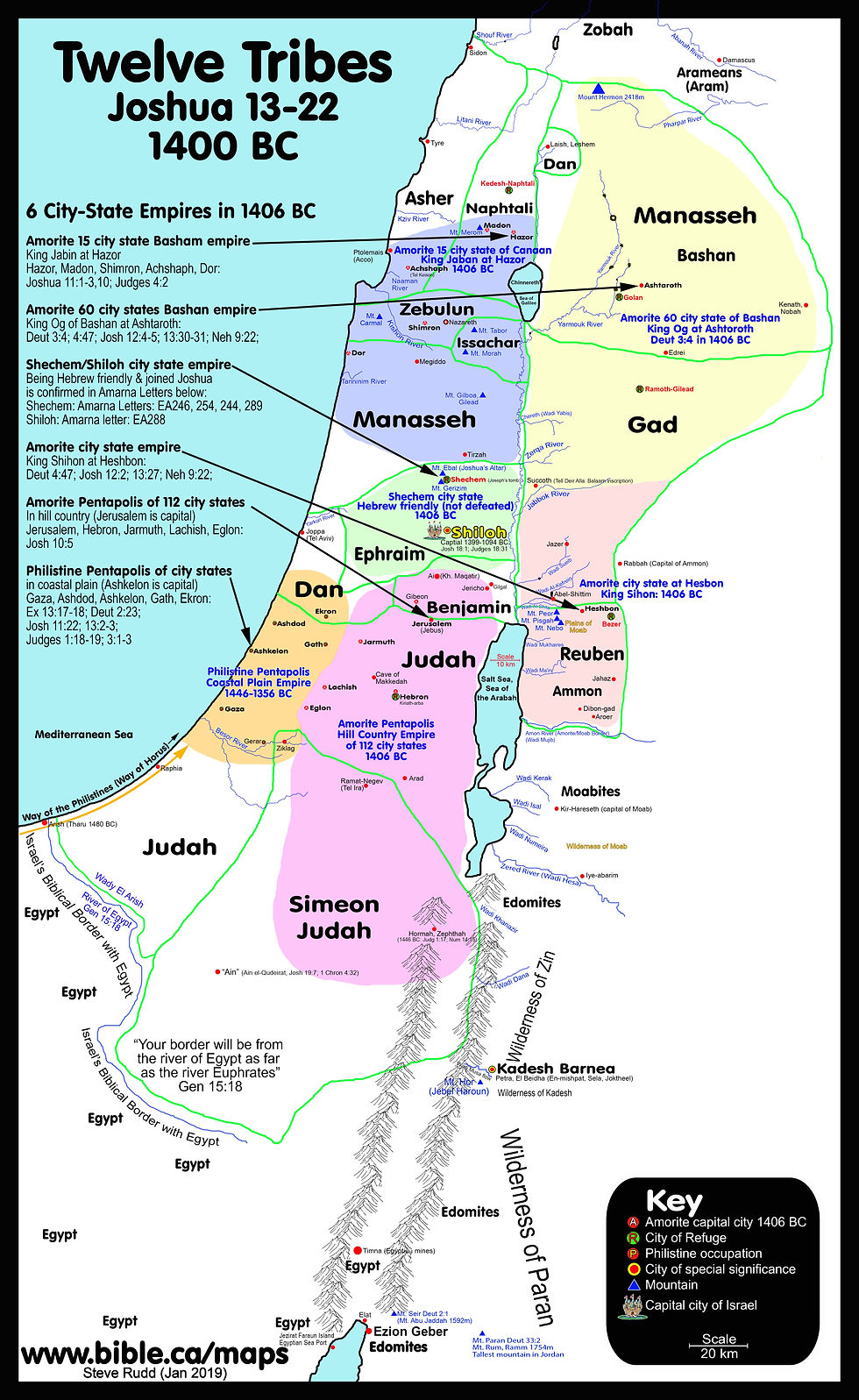
Multiple scholars have noted the efficiency of Joshua's military campaign. It was well-organized and executed, and he achieved his military goals quickly. And yes, it really helps when the Lord is fighting on your side.
Themes
All the best commentators note that God is the central character of this book. That leads to several key themes:
God is the divine Warrior who leads His people into battle
God has led His people into a Holy War (more about this below)
God is giving His people the Promised Land
God renews His covenant with His people
God is merciful and just
God will give His people rest
And this leads us to one primary message (I get this from Madvig's commentary):
He wanted to proclaim that Israel was blessed at this time of the Conquest because she was faithful to her God and to his law and that this would be the secret of Israel's success and blessing in every generation.
This message would be true no matter which generation of God's people read this book.
This Week's Big Idea: God's Holy War in Canaan
Joshua is one of the most controversial books in the Bible because it describes God's war against the people living in Canaan. That rubs some people the wrong way. "How can the New Testament 'God of love' and the Old Testament 'God of hate' be the same God?"
We've talked about this a lot (because it's persistent in our culture), and it will come up again this quarter.
Let's start here: there's only one God, and the "God of the Old Testament" is not a "God of hate". In many ways, God's actions in this book are "tame" compared to His final war against sin in the book of Revelation in which He destroys the earth and condemns all unrepentant sinners to an eternity in hell! But it's all the same war -- God's war against sin.
The naysayers willingly ignore God's merciful actions in this book (and throughout the Old Testament).
For starters, God willingly sent His own people into slavery for 400 years to give the inhabitants of Canaan an opportunity to repent (Gen 15:16). And moreover, all who did repent (like Rahab and her family) were accepted into God's people. Even the Gibeonites (chapter 9), who felt they needed to use deception, were accepted into the safety of God's people.
And then we have the reality of the "holy war". I think that some people have in mind that God ordered His fighting men to seek out unsuspecting villages and massacre babies. But that isn't what happened. We'll talk about some of this as we go through the book. Those ordered killed were combatants in war. They were militants occupying forts and garrisons throughout Canaan. Everyone who left was allowed to leave. Everyone who stayed to resist was a threat to God's people. Yes, that means that children were caught up in the devastation, which is heartbreaking, but also very true-to-life.
Attitudes towards the current war in Iran might illustrate why this scenario is so controversial among some. Nobody should want to see non-combatants suffer or die. But the leadership of Iran and its proxies in Lebanon and Palestine have openly declared their desire to kill every man, woman, and child in Israel. And also use non-combatants as shields. What is Israel supposed to do? What would you do?
So it was in Joshua's day. Their "neighbors" weren't passively sitting around, minding their own business. They were enemies of God who, in the names of their own gods, engaged in a holy war against God and His people. They actively engaged in sinful behaviors (like, for example, child sacrifice). And because the God of the Israelites opposed their false gods, they wanted to wipe out the Israelites.
At the heart of all of this is the Promised Land. God promised this land to Abraham's descendants. The Canaanites were the interlopers. (Again, attitudes towards what's currently happening in the political boundaries of Israel are informative.) Those Canaanites could (1) repent and join with God's people, or (2) leave.
Many Christians are uncomfortable with the events in this book, and I certainly understand why. I have chosen to trust God's character and God's perception. Indeed, God sent the same devastation against His own people when their sinful behavior demanded their punishment.
But in any event, God has not commanded us to do this. Joshua points us to a deeper, cosmic conflict with the forces of evil. And that's the battle we fight today.
I don't think that makes our study any easier to swallow. But let's ask God to help us know how to explain these events to someone who doesn't understand them.
Part 1: Let's Get Right to It (Joshua 1:1-5)
1 After the death of Moses the Lord’s servant, the Lord spoke to Joshua son of Nun, Moses’s assistant: 2 “Moses my servant is dead. Now you and all the people prepare to cross over the Jordan to the land I am giving the Israelites. 3 I have given you every place where the sole of your foot treads, just as I promised Moses. 4 Your territory will be from the wilderness and Lebanon to the great river, the Euphrates River—all the land of the Hittites—and west to the Mediterranean Sea. 5 No one will be able to stand against you as long as you live. I will be with you, just as I was with Moses. I will not leave you or abandon you.
The book of Joshua doesn't mess around. The people mourned the death of Moses for 30 days, and then God moves them on. Nothing can change the fact that Moses is dead, and now Joshua has work to do.
Obviously, God's endorsement is key to Joshua's transition. But let's also realize that God endorsed Joshua because Joshua was worthy of the job (so to speak). He was the leader that the people needed, and they could see it. (In other words, it's both/and -- God declared Joshua a leader, and Joshua was qualified to be that leader.)
People once told me that an interpretation of 1:4 was driven by politics. I had no idea what that meant until I saw a map like this one:

Oh. Now I get it. By making the Euphrates the northern and eastern border of the Promised Land, some people can say that large swaths of Syria and Iraq (and more) should actually belong to the Jews. Yep, that's political.
As far as I can tell, the description of the territory is political enough without taking it to that extreme. Solomon's kingdom, at its fullest extent, seems to me to represent the territory that God was talking about in 1:4. And no, there was no way they could maintain that "empire" -- that was the whole point. Kingdoms maintained by human strength cannot last.

In any event, this map shows one understanding of what was actually settled, which is definitely not as large as 1:4 can be made out to sound.

With apologies, here's one more map. I'll probably bring it back when we have another list of tribal names. "Canaanites" would often be used to refer to all of the tribes living in the land of Canaan, and "Hittites" would be used to refer to all of the tribes living further north (even though they also lived in the south; I'm not an anthropologist).

Anyway, the real point of all of this is not the maps, it's the promise from God -- God will be with Joshua just as He was with Moses, and Joshua will succeed in everything he does because God will give him success.
This first section of the lesson would be getting acclimated to where we are in the Bible.
Part 2: God's Instructions (Joshua 1:6-11)
6 “Be strong and courageous, for you will distribute the land I swore to their ancestors to give them as an inheritance. 7 Above all, be strong and very courageous to observe carefully the whole instruction my servant Moses commanded you. Do not turn from it to the right or the left, so that you will have success wherever you go. 8 This book of instruction must not depart from your mouth; you are to meditate on it day and night so that you may carefully observe everything written in it. For then you will prosper and succeed in whatever you do. 9 Haven’t I commanded you: be strong and courageous? Do not be afraid or discouraged, for the Lord your God is with you wherever you go.”
10 Then Joshua commanded the officers of the people, 11 “Go through the camp and tell the people, ‘Get provisions ready for yourselves, for within three days you will be crossing the Jordan to go in and take possession of the land the Lord your God is giving you to inherit.’”
If we take this section back to the end of verse 5, you can see the structure that tells us everything we need to know about this book:
a: I will not leave you
b: Be strong and courageous
c: Be strong and very courageous
d: Observe carefully this instruction
e: Keep this book of instruction
e': meditate on it day and night
d': carefully observe everything in it
c': Be strong and courageous
b': Do not be afraid or discouraged
a': The Lord your God is with you
(All my poetry nerds, that's a chiasm.)
Promise
Challenge
Command
Challenge
Promise
God's promise is the foundation for everything He asks of Joshua. His promise to be with Joshua should give Joshua hope and courage. But the key -- the focus -- is the center: God's command that Joshua (and the people) keep the law.
This exact structure works for us as Christians today, right? Think about something we just studied:
Matt 28:18 Jesus came near and said to them, “All authority has been given to me in heaven and on earth. 19 Go, therefore, and make disciples of all nations, baptizing them in the name of the Father and of the Son and of the Holy Spirit, 20 teaching them to observe everything I have commanded you. And remember, I am with you always, to the end of the age.”
Jesus might not have used a chiasm, but the content of promise / challenge / command is almost identical.
To that end, we do claim a version of Joshua's promise for ourselves. Following the Old Testament law was daunting in and of itself; adding to that the command to occupy the Promised Land pushed this task into near-impossible territory.
But is that not true of Christians -- now that we see where the Old Testament was pointing? Willing to follow Jesus even unto death? Taking His message to literally every person in the entire world? Not for the faint of heart!
But let's get back to Joshua.
Verse 7 makes it clear that obedience itself requires courage. I strongly encourage you to take a detour here: how might obeying Jesus require courage?
Voice of the Martyrs always has a challenging story that relates to any passage in the Bible about courage or danger. Here's what was in my inbox this morning:
I like God's use of "right or left" -- it's a very clear image. You can find it throughout the Bible: BibleGateway - Keyword Search: right left My favorite related image comes from the Exodus:
and the Israelites went through the sea on dry ground, with the waters like a wall to them on their right and their left.
What better way to experience the importance of staying on the path?
But the best-known instance might come from Isaiah chapter 30, where God promises future mercy to His wayward people:
18 Therefore the Lord is waiting to show you mercy, and is rising up to show you compassion, for the Lord is a just God. All who wait patiently for him are happy.
19 For people will live on Zion in Jerusalem. You will never weep again; he will show favor to you at the sound of your outcry; as soon as he hears, he will answer you. 20 The Lord will give you meager bread and water during oppression, but your Teacher will not hide any longer. Your eyes will see your Teacher, 21 and whenever you turn to the right or to the left, your ears will hear this command behind you: “This is the way. Walk in it.”
The reference to "depart from your mouth" was understood literally. Theirs was an oral culture -- they read out loud (even to themselves). That's an aid for learning and memorizing.
Memorization Exercise: pick either verse 7 or 8 (they're pretty complex). Read that verse silently to yourself 5-10 times and see if you have it memorized. Then, take the other verse and read it out loud to yourself 5-10 times and see if you have it memorized. Which method worked better for you?
The big topic for this passage: God directly connects "prosper and succeed" with "obey My instruction" -- why? And how does that work? Is it still true today?
(That's an important question to fully understand. What does it mean to "prosper and succeed"? What are we told we will prosper and succeed at?)
Joshua was indeed strong and courageous. He didn't waste any time at all. The people would have three days to get ready to cross the Jordan!
(At flood stage. Without boats or a bridge.)
Part 3: The People's Response (Joshua 1:16-18)
16 They answered Joshua, “Everything you have commanded us we will do, and everywhere you send us we will go. 17 We will obey you, just as we obeyed Moses in everything. Certainly the Lord your God will be with you, as he was with Moses. 18 Anyone who rebels against your order and does not obey your words in all that you command him, will be put to death. Above all, be strong and courageous!”
This sounds brazen, right? After all, we know what's coming in the book of Judges, right? But let me remind you what was written at the end of Joshua:
24:31 Israel worshiped the Lord throughout Joshua’s lifetime and during the lifetimes of the elders who outlived Joshua and who had experienced all the works the Lord had done for Israel.
This doesn't mean they were perfect, but this generation tried to keep their word. Their children and grandchildren may have been a different story, but the people who spoke verses 16-18 did speak from their hearts.
We will see the people's obedience and bravery in action when we study Joshua.
But I do want us to peek ahead to the failures in Judges. We'll talk a lot more about this when we get there, but know that Judges covers a period of about 300 years. For context, America is about to turn 250, and a bunch of people seem to make their livings today talking about "how much things have changed" around here. And even more seem to make their livings talking about "what happened to America". We don't need to attempt to litigate that on a Sunday morning.
But we can set up a general scenario: the people of Joshua's generation faithfully served the Lord; their grandchildren and great-great-grandchildren did not. What might have happened?
We don't want that to happen to our grandchildren and great-great-grandchildren. What can we do to prevent it?
I almost hate to tell you that we can't prevent it. Our children, our grandchildren, they are their own people, and they will answer to God for their own choices and actions. But I do want to make sure we understand a very important (and well-known) Proverb. Many of us are familiar with the King James version of it:
22:6 Train up a child in the way he should go: and when he is old, he will not depart from it.
We take from this that when a child strays, it must be the parents' fault. Indeed, many Christian parents I know blame themselves for their children's waywardness.
But let me put that to rest with a simple question: are the Proverbs promises, or warnings? They're warnings. That means we should more read this Proverb to be
If you do not train up a child in the way he should go, when he is old, he will have no path to follow.
Does that make sense?
[Aside: a soapbox. This parenting "strategy" that says "I won't force my child to church or teach my child the Bible because I want him to make his own decision of morality" is abjectly absurd, unbiblical, and unchristian. The books of Joshua and Judges give us the clearest illustration of why God commanded us to teach our children His truth!]
Somewhere after Joshua's generation, they failed to teach the next generation. And who knows, maybe that started with Joshua's generation! Maybe they were so concerned with personal obedience that they neglected teaching their children! But that in itself is foundational disobedience. Just remember Deuteronomy 6.
As Christians, our calling is to teach our children and lead them to follow Jesus. Whether or not they do is their own choice. But we are to teach them to do so because that is what Jesus told us to do. And we have His promise that He will be with us when we do, so we can have the courage to trust Jesus to do what in right in our children's lives. And their children's. And their children's. Does that not give you comfort? This is not about our strength and faithfulness -- it's about God's.
In fact, I'm going to cite Deuteronomy 6 in full so you can clearly see the connection between Joshua 1 and everything we have studied in the Bible to this point. And I'll just let this be the end of my notes. What are we doing as families and as a church to take God's words to heart?
6:1 “This is the command—the statutes and ordinances—the Lord your God has commanded me to teach you, so that you may follow them in the land you are about to enter and possess. 2 Do this so that you may fear the Lord your God all the days of your life by keeping all his statutes and commands I am giving you, your son, and your grandson, and so that you may have a long life. 3 Listen, Israel, and be careful to follow them, so that you may prosper and multiply greatly, because the Lord, the God of your ancestors, has promised you a land flowing with milk and honey.
4 “Listen, Israel: The Lord our God, the Lord is one. 5 Love the Lord your God with all your heart, with all your soul, and with all your strength. 6 These words that I am giving you today are to be in your heart. 7 Repeat them to your children. Talk about them when you sit in your house and when you walk along the road, when you lie down and when you get up. 8 Bind them as a sign on your hand and let them be a symbol on your forehead. 9 Write them on the doorposts of your house and on your city gates.
10 “When the Lord your God brings you into the land he swore to your ancestors Abraham, Isaac, and Jacob that he would give you—a land with large and beautiful cities that you did not build, 11 houses full of every good thing that you did not fill them with, cisterns that you did not dig, and vineyards and olive groves that you did not plant—and when you eat and are satisfied, 12 be careful not to forget the Lord who brought you out of the land of Egypt, out of the place of slavery. 13 Fear the Lord your God, worship him, and take your oaths in his name. 14 Do not follow other gods, the gods of the peoples around you, 15 for the Lord your God, who is among you, is a jealous God. Otherwise, the Lord your God will become angry with you and obliterate you from the face of the earth. 16 Do not test the Lord your God as you tested him at Massah. 17 Carefully observe the commands of the Lord your God, the decrees and statutes he has commanded you. 18 Do what is right and good in the Lord’s sight, so that you may prosper and so that you may enter and possess the good land the Lord your God swore to give your ancestors, 19 by driving out all your enemies before you, as the Lord has said.
20 “When your son asks you in the future, ‘What is the meaning of the decrees, statutes, and ordinances that the Lord our God has commanded you?’ 21 tell him, ‘We were slaves of Pharaoh in Egypt, but the Lord brought us out of Egypt with a strong hand. 22 Before our eyes the Lord inflicted great and devastating signs and wonders on Egypt, on Pharaoh, and on all his household, 23 but he brought us from there in order to lead us in and give us the land that he swore to our ancestors. 24 The Lord commanded us to follow all these statutes and to fear the Lord our God for our prosperity always and for our preservation, as it is today. 25 Righteousness will be ours if we are careful to follow every one of these commands before the Lord our God, as he has commanded us.’


Comments